Servicing and maintenance
A pool is kept all year, not just in summer.
Étale maintains the water, the plant and the surfaces of the pools it has built, and of those it has not. Private pools, spa baths, wellness areas, hotel, care facility and public basins: the contract is written around what the installation actually needs, not around a standard package.
What maintenance covers
Three things age, and not at the same speed.
A pool is not one object: it is a body of water, a set of machines and a set of surfaces, and each wears differently. Treating them as one is the most common reason a heavy repair replaces what could have been a visit.
Chemical balance, filtration, disinfection. This is what drifts fastest and is easiest to correct, as long as it is seen coming.
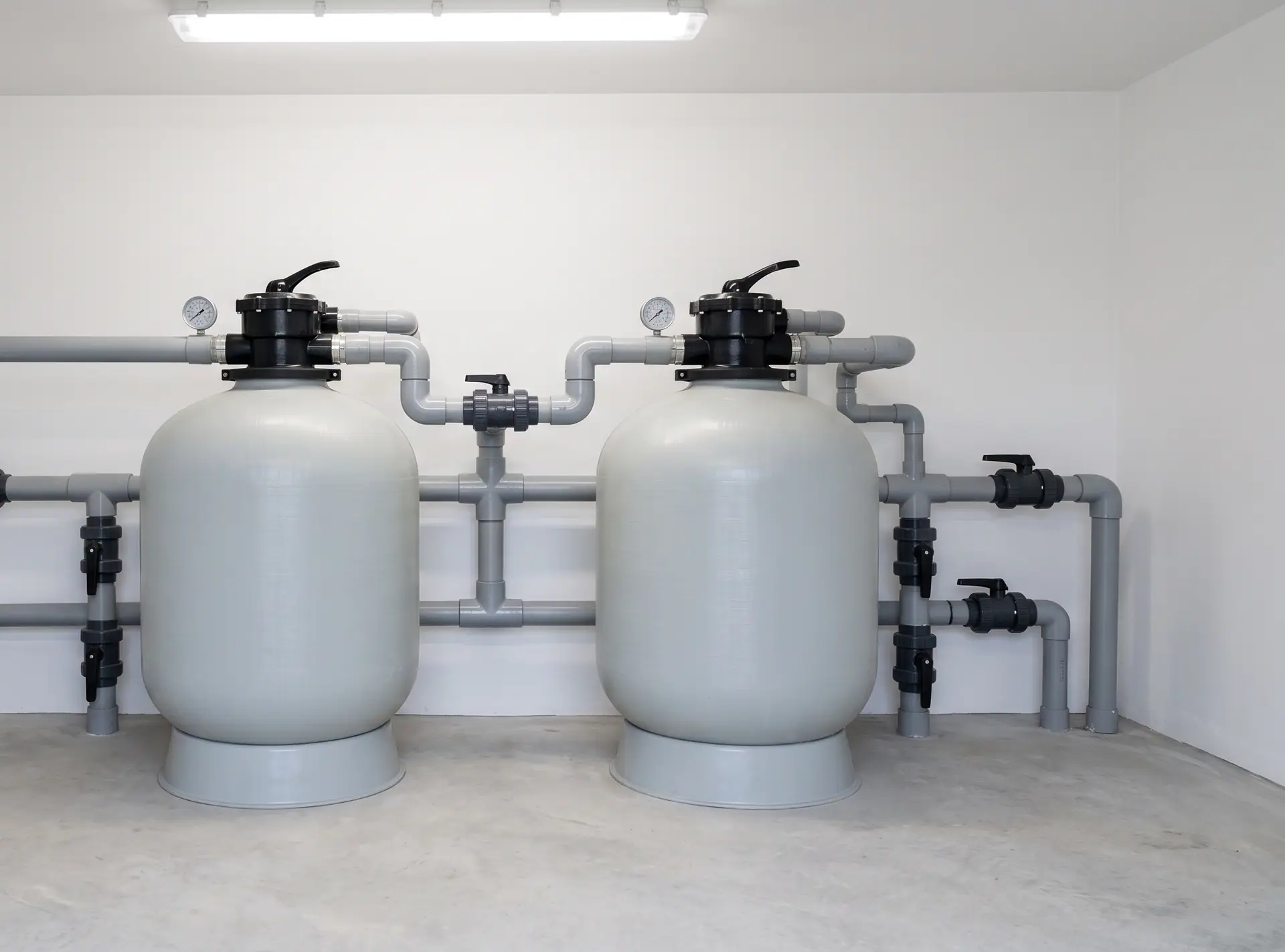
Pumps, filters, treatment, control, heating. It rarely fails without warning: it draws more power, runs hotter, holds pressure less well.
Lining, joints, waterline, copings, overflow channel. They move slowly, which is exactly what makes them easy to ignore until the repair is no longer maintenance.
Who for
A household and a hotel do not have the same problem.
The technical work is similar, the organisation is not. What differs is not the difficulty but the constraint: in a home, availability; in an establishment, an operation that never stops.
Pool, jacuzzi, home wellness area. Opening and closing the season, water monitoring, plant room upkeep.
Pools, spas and jacuzzis in operation. The constraint fits in one sentence: the pool stays open to guests, and visits are planned around that.
Rehabilitation and balneotherapy pools. Regularity matters more here than anywhere else, because the users are vulnerable.
Corporate wellness areas, club and sports centre pools, municipal installations.
The contract
What a maintenance contract must state before it is signed.
A maintenance contract is judged on what it names, not on its headline price. Four points deserve to be written down, and they are discussed on site because they depend on the installation.
The line between routine maintenance and repair. It is what prevents the unpleasant surprise, in both directions.
It depends on volume, treatment type, usage and season. A hotel pool open all year and a family pool do not call for the same rhythm.
Who calls whom, within what time, and what happens to the operation meanwhile. Agreed beforehand, never during.
Treatment products and wear parts: included or invoiced, the answer changes what the contract really costs.
An installation we did not build
Taking over the maintenance of someone else’s pool.
This is the most common case, and it raises no objection in principle: an installation can be read. The first visit is there to understand what was done, what condition it is in today, and what needs a decision before going under contract. A pool whose plant room is past its age, or whose waterproofing is at the end of its life, does not go under contract without that being said: putting regular maintenance on an installation that needs rebuilding means paying twice.
Next
What happens next.
A maintenance contract begins with a visit. It is how we see the installation, say what it needs, and write a contract that matches that installation.
Your next pool or wellness space
Everything begins with a meeting.
A place, a wish, a project to imagine together.