
A call you can reopen, to the second.
The conversations actually held, replayable, with a score computed on seven weighted axes and comments placed at the exact moment it played out. Clicking a comment replays the passage. That is what turns a debrief from memory into coaching on evidence.
Why does call review never really happen?
Because it means finding the right recording, listening to all of it, noting the moment that counts, then telling it to someone who did not hear it. Four points of friction, enough for it never to happen, week after week.
Finding the right call takes longer than listening to it
The recording lives in the phone system, the record lives in the CRM, and nothing links the two. You search by number and by date, by hand.
The feedback arrives a week too late
Advice given eight days after the conversation is about a memory, not a fact. The rep no longer remembers exactly what they said, so they do not correct it.
The feedback does not get read
A document sent by email disappears into a full inbox. Without proof of reading, you do not even know whether the analysis reached the person concerned.
We score the impression, not the move
"He was good" or "he went too fast" cannot be corrected. What can be corrected is a precise sentence, at a precise moment, in a conversation you can reopen.
How do the recordings reach the CRM?
The phone system sends every conversation through with its duration, its contact and its audio track, attached to the record concerned. The audio is never served from a public address: it goes through a relay that first checks the person is allowed to hear it.
Attached to the right record
The call arrives with its number, its date, its duration and the company concerned. No more cross-searching between two tools to find a conversation.
Audio that does not leak
The recording does not open from a guessable address. Every listen goes through a scope check: a rep hears their own calls, a manager hears their team's.
Filterable like a real work queue
By person, by period, by minimum duration, by read state and by color marker. In two clicks you isolate the conversations over five minutes long that were never opened.
Voicemails as well
Messages left on voicemail are handled separately, in their own queue, so they do not pollute the review of the conversations actually held.
How is a call scored?
Seven axes are scored out of ten, each with a fixed weight, and the weighted average gives the call score as a percentage. An axis that has no reason to apply to that call is ignored rather than counted as zero: a forty-second call has no close to score, and that is not a fault.
| Axis | Weight | What we look at |
|---|---|---|
| Accuracy | 25% | Is everything that was stated true? Lead times, prices, scope, promises. |
| Discovery | 20% | Open questions, silences left, need genuinely understood. |
| Buying signals | 15% | Pain, budget, deadline: spotted and picked up, or let go. |
| Close | 15% | Next step clear and dated, commitment obtained. |
| Objections | 10% | Welcomed and explored, or swept away with a discount. |
| Opening | 10% | The first twenty seconds: reason given, timing checked. |
| Listening | 5% | Talk ratio, echo prompts, no monologue. |
Accuracy carries the most weight, and that is no accident: false information given on the phone commits the company. A lead time invented to close becomes a promise someone will have to keep, or explain.
The thresholds are deliberately demanding: seventy percent is a good call, not the average.
What does a call comment look like?
Like a point placed on the timeline, with its minute and its second, its category and its severity. Clicking it replays the passage concerned, five seconds before and five seconds after, then playback stops by itself.
Four categories, and nothing else
Well played
What worked and deserves to be done again. A call is not only a list of faults, and a rep who reads nothing but criticism stops opening their feedback.
Needs work
A move that is correct but improvable: a closed question where an open one would have given more, a follow-up placed too early.
Incorrect information
An inaccurate statement given to the prospect. It is the category with the heaviest consequences, and the one that weighs the most in the score.
Missed opening
A signal given by the prospect and let go: a budget mentioned without being picked up, a deadline mentioned without being explored.
Three levels of severity
Every point is minor, notable or major. Three minor points do not make a problem, one major point does.
A point can also stay pending, with the question still to be settled shown exactly as it stands. Better an open question than an invented judgment.
Here is a seventeen-minute call, scored and commented
Start playback: the playhead runs through the conversation and each comment appears at the moment it was placed. Click a point to jump straight to it. On the right, the overall score is recomputed from the seven axes and their weights.
Call no. 412
Outbound call · 17 min 18 · recording from the phone system
Call score
59 %
The 7 axes are scored out of 10, weighted, then brought back to a percentage. The figure above is computed from the table, it is written nowhere.
585 points out of 1000 · 7 axes scored out of 7 · 100% of the scale counted
In the CRM, clicking a point replays the passage: five seconds before, five seconds after, then playback stops by itself.
The 7 axes, and what each one weighs
- Accuracy4/10· 25 %
- Discovery8/10· 20 %
- Buying signals5/10· 15 %
- Close4/10· 15 %
- Objections7/10· 10 %
- Opening9/10· 10 %
- Listening6/10· 5 %
The percentage on the right is the weight of the axis in the overall score. Accuracy carries the most weight: false information given to the prospect commits the company. An axis that is not scored is ignored and its weight leaves the divisor, it is never counted as zero.
7 points raised
- Well playedminor
Clean opening: the reason for the call is given in two sentences, without jargon, and the prospect's availability is checked before moving on.
- Well playednotable
Very good open question about where their customers currently come from. The silence is left, and the prospect talks on their own for nearly a minute.
- Needs workminor
Three questions strung together without leaving time to answer. Ask the question, then say nothing: the real need almost always comes out in the silence.
- Incorrect informationmajor
Hosting is presented as included in the subscription. That is false, it is billed separately, even when the site is built by us. To be corrected with the prospect before the proposal goes out.
- Missed openingnotable
The prospect says they already pay every month for a page that brings them nothing. A clear buying signal, let go: that was the moment to make them say what it costs them over a year.
- Incorrect informationmajor
"We are Google partners" is dropped in to reassure. The company is nobody's partner. What is true, and enough: people on the team are certified by Google.
- Needs workmajor
Call ends with no dated next step, on an "I'll send you all of that". A firm appointment is booked during the call, day and time, not afterward.
Demonstration reconstructed with the real labels, weights and thresholds of the product. The audio is not played.
What does the Calls and feedback module look like?
A queue of conversations with their duration, their percentage score and the number of points raised, filters by person, period and duration, and at the top the average call score, the number of unread pieces of feedback and the number of calls still without analysis.
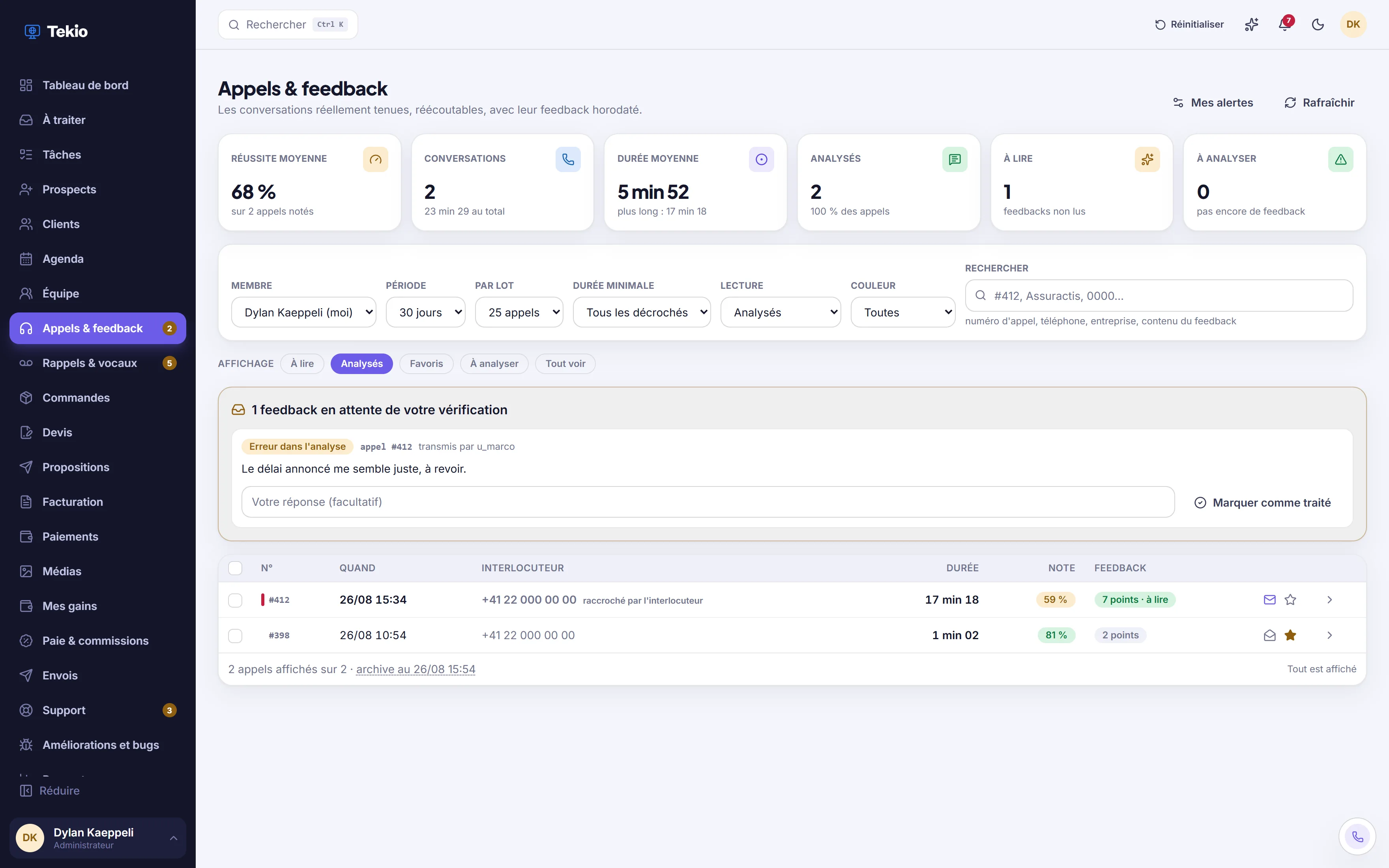
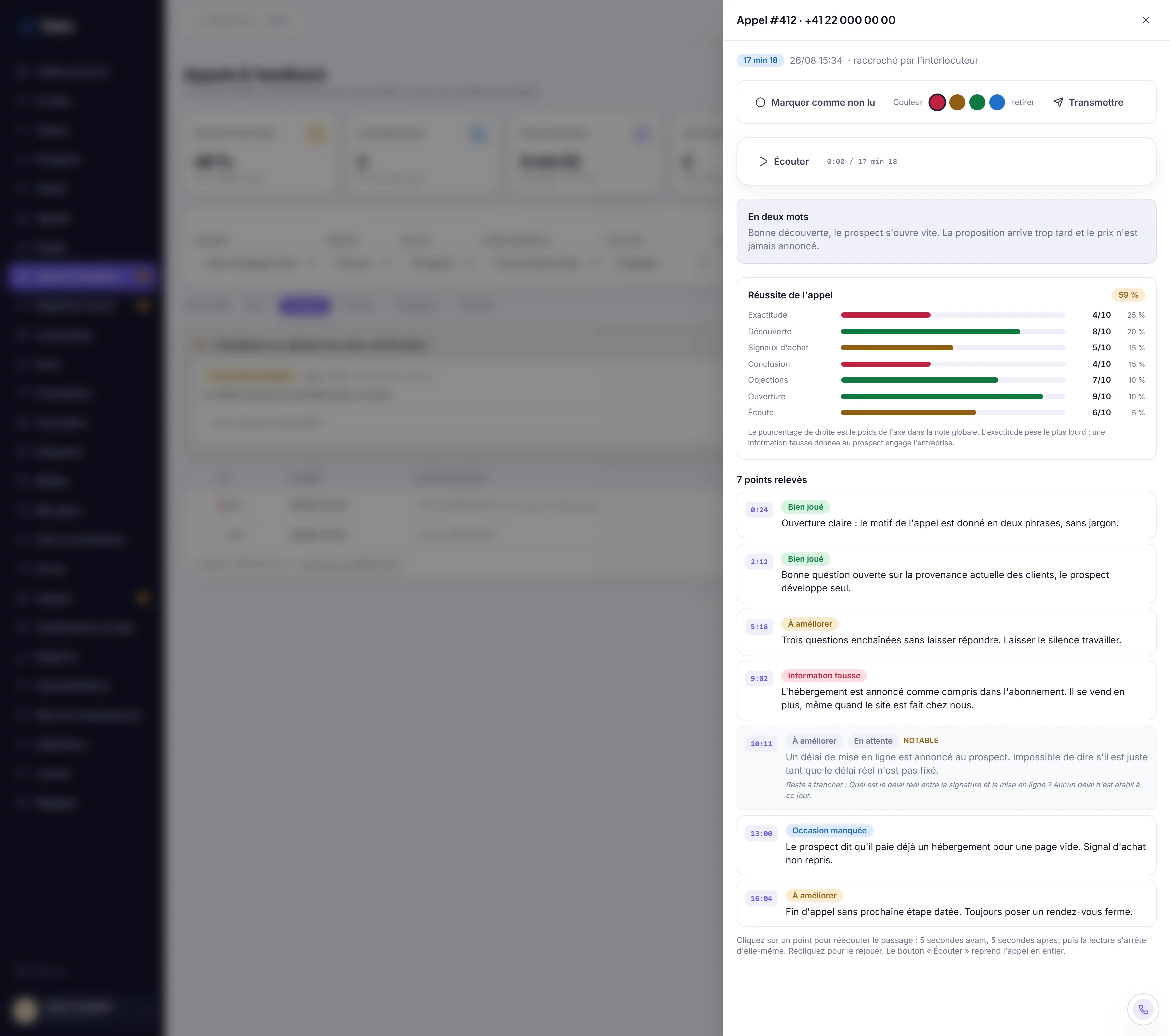
Screenshots of the Tekio CRM in demo mode, fictional data.
How do you know the feedback was any use?
Because reading is tracked. The CRM shows who opened their feedback, how long afterward, and on which days they opened nothing at all. It is a view, not a lever: there is no button to mark feedback as read on someone else's behalf.
The rep marks, sorts and sets aside
They open their feedback, mark it read, add a color (to review, to rework, handled, good example) and favorite the calls they want to hear again.
They can disagree, and say so
Feedback can be sent on to a manager with an explicit reason: verification requested, error in the analysis, disagreement, advice requested, or good example to share. Disagreement is part of the setup.
The manager sees the reading, not only the score
Feedback received, feedback opened, share opened, the usual delay before reading, days with nothing opened, and a day-by-day timeline. If nobody opens it, writing more of it serves no purpose.
An alert when it matters
A badge warns that unread feedback concerns a long conversation. The threshold is set per person, so attention is not drowned.
What does this module not do?
Four limits to know before committing, rather than after. They do not show up in a sales demonstration, but they show up on the first Monday of use.
The CRM does not display the transcript
The transcript comes from the phone system and it is kept, but no screen displays it today. What you read on screen is the summary, the score and the timestamped points.
Feedback is not written inside the screen
The CRM is there to listen, read, mark and forward. The analysis itself is written outside the interface and stored in the database. If you want a built-in feedback editor, that is development to plan for, not a box to check.
A very short call cannot be analyzed
Below about fifteen seconds, the transcript is almost never produced and there is nothing to analyze. The CRM says so plainly rather than showing an empty score.
The recording does not go back in time
A conversation only has an audio track from the day recording is switched on for your line. Earlier calls stay listed with their duration, but they cannot be replayed.
Recording calls means informing the people on the line, and the rules vary from one state and one country to another depending on where you call. That is something we frame with you when we connect your telephony, not a box to check.
When did you last listen back to one of your team's calls?
Thirty free minutes to look at how your calls are followed today, what your phone system already records without anyone using it, and what a real feedback loop would change for you.