
From what we know before picking up the phone to the client's signature.
The rep opens the lead record and already knows what is wrong at the prospect's end, with the figure that proves it. The discovery fills in the quote while they talk. Pricing happens live, VAT works itself out, and the proposal goes out with a link the client signs on screen.
- 01Armed before picking upmeasured signals, with the figure that proves them
- 02The discovery fills in the quoteyou listen, the boxes check themselves
- 03Priced during the callcurrency, term, payment schedule, discount, commission
- 04Signed with no accounta private link, a stroke on screen, a frozen document
What does the rep know before even picking up the phone?
What is publicly visible and verifiable: the prospect's position in the local results, their rating and their number of reviews, whether a site exists and what state it is in, whether there is a form, whether the number is clickable or not. Every finding is shown with the figure behind it.
The rule that makes the lead record reliable
Two kinds of information, never mixed. What has been measured is stated, with its numeric proof. What cannot be seen from the outside becomes a question to ask, never a statement. That is what stops the rep stating something false in their second sentence.
The order to raise them in
Visibility in the results, then reviews, then site. The order is not neutral: someone nobody can find does not have a site problem, they have an existence problem.
The safeguard
Nothing is displayed if the analysis did not really run on the prospect's own site. A rating of zero means "no reviews", never "badly rated". An empty field is not information, it is an absence of information, and the CRM refuses to confuse the two.
Three prospects, three different arguments
Choose a lead record: the CRM applies its rules to the signals collected and separates what can be stated from what has to be asked. The thresholds shown are the ones in the product.
Three records, three situations
Fictional examples. Choose a record: everything that follows is recomputed from its signals, nothing is written in advance.
Record Fiduciaire Ambrelin. What is measured: 1. What has to be asked: 3.
Fiduciaire Ambrelin
Accounting and bookkeeping · Nyonmeasured: 1 · to ask: 3What their public listing gives
The raw signals, before any interpretation. What was not measured stays marked as such.
- Google rank
- 6measured on "accounting firm Nyon"
- Number of reviews
- 62
- Google rating
- 4,9★
- Site on their listing
- facebook.com/fiduciaire-ambrelin
- Site analysis
- landed on a Facebook page
- Speed
- 31/100recorded, but set aside
- Form
- absentrecorded, but set aside
- Number on mobile
- absentrecorded, but set aside
The analysis did not run on their site: nothing it recorded will be stated on the phone.
The order we raise them in
The order of the call script, and it does not change: what is costing them customers today comes before what would cost them customers tomorrow.
- 1Google visibility1
- 2Google reviews0
- 3Site0
What is measured
Can be stated on the phone, because the figure is there to prove it.
They come up at number 6 on "accounting firm Nyon".
Rule triggeredrank 6 > 3
What it opens : SEO and local search
This is the first sales argument, and it checks out live: their rank is public, they can see it for themselves during the call.
Set aside on this record
- Rebuild or repair of the site· the analysis is not about their site
- Contact form on their site· the analysis is not about their site
- Clickable number on mobile· the analysis is not about their site
What has to be asked
Invisible from the outside. It gets asked as a question, never stated: a question cannot be turned back on you.
Right now, what do you track your quotes and your customers in? A file, a notebook, your head?
What it opens : Custom CRM, automated end to end
As soon as they mention an Excel file, a notebook or several tools that do not talk to each other, there is a CRM to build.
Are there things you retype several times, in the same places, every week?
What it opens : Automations (what they redo by hand every week)
Re-entry is the most reliable signal: a quote copied out into an invoice, follow-ups done by hand, appointments noted twice.
Who looks after your hosting and your email addresses today?
What it opens : Hosting, domain name and email addresses
If they cannot answer, or if it is "a friend's nephew", that is a dependency and a risk.
Product cap: 3 questions at most. This record produces 4, the rest is not displayed.
Set aside on this record
- Voice agent (the switchboard that answers for them)· office-based business, the question makes no sense
- Newsletter and win-back of past customers· beyond the product's cap
The safeguard
- Nothing is displayed if the analysis did not really run on the prospect's own site: a Facebook page, a login screen or a hosting provider's help page cannot be held against anyone.
- A Google rating of 0 means "no reviews", never "badly rated".
- An empty field is not information.
Fictional companies, created for the demonstration.
How does the conversation become a quote?
Through a guided discovery in six topics, where each answer checks the boxes of the quote directly. The rep asks questions and listens, they do not fill in a form: the pricing builds itself behind the conversation.
The six topics
Your visibility
How people find you today, and which route customers arrive by.
Your reviews
What people write, who replies, and what happens when a review is bad.
Your phone
Who picks up, what happens when nobody picks up, and what that costs.
What takes up your time
The tasks repeated by hand, the ones nobody likes doing, the ones that get forgotten.
Your customer follow-up
Where customers live today, and what gets lost between two tools.
Your site
What it does, what it does not do, and how long since anyone touched it.
Two topics explored, not six
The discovery deliberately stops at two topics explored in depth. A conversation where you dig into everything becomes an interrogation, and the prospect hangs up before the end.
No budget question
Budget is not asked during the discovery. You look for what hurts, and the pricing comes afterward, opposite the need expressed.
The discovery prices nothing
It qualifies, it does not calculate. The price appears in the quote, not in the exploratory conversation.
How does the quote get built live?
The rep checks the services discussed, chooses the currency, the commitment term and the payment schedule, and reads straight away the annual subscription, the one-time fees, the total over the term and their own estimated commission. All of it while the prospect is still on the phone.
Four currencies, two languages
Swiss franc, euro, dollar, pound, and a document produced in French or in English. The currency changes the display, not the tax regime.
Term and payment schedule
One to five years of commitment, billed annually, semiannually, quarterly or monthly. Extra billing fees are shown, not hidden in a footnote.
A deposit when it makes sense
Half on signature, the balance on delivery, in one button. That is what unblocks the projects where the client hesitates to pay everything up front.
Recommended price, floor price
Every service has its recommended price and its floor. Going below stays possible, but it is flagged on screen and the rep's commission is reduced. A discount has a cost, and it is visible at the moment it is granted.
The commission is visible while you price
The rep reads their estimated commission at the same time as they adjust the price. They decide knowing what it costs, instead of discovering the effect of their discount at the end of the month.
A brochure with no prices, if needed
When the prospect wants to show something to a partner first, we send a presentation of what was discussed, with no figures. The quote follows when the decision gets closer.
What happens when the VAT is not clear?
The proposal does not go out. The applicable regime is worked out from the country and the status of the client, and it is shown throughout the pricing. As long as it remains to be confirmed, the send button is disabled and the reason is written next to it.
The regime is computed, it is not chosen
Swiss VAT, reverse charge inside the EU, service supplied abroad, not liable: the case follows from the information on the record rather than from a box checked at random by the rep.
The block holds on the server too
It is not only a grayed-out button in the interface. The server refuses the send before any write and before any email. Working around it in the browser gets you nowhere.
A wording visible throughout the pricing
The rep sees the regime and its wording while they adjust the prices, not only at the moment of sending. They correct the record while they still have the client on the phone.
How does the client sign the proposal?
They receive a branded email with the priced detail and a private link. The page opens with no account and no password: the link itself is the secret. They read it, they can ask for a change, or they sign with a stroke on screen, with the mouse or with a finger.
No account to create
The number of proposals lost because a client did not want to create yet another account is hard to measure, but it is not zero. Here, the link is enough.
What is signed is frozen
The signature, its timestamp and the version of the terms and conditions are sealed into a fingerprint of the quote, and the document becomes unmodifiable, locked all the way down into the database.
The right of withdrawal is written down
The mention of the fourteen days appears on the signature page, with the version of the terms and conditions applicable that day. It is not in an appendix you discover in the event of a dispute.
Signing in person or remotely
In a face-to-face meeting, acceptance of the terms is checked explicitly before the button becomes active. Remotely, the text shown speaks of an agreement in principle, because that is what it is.
This is not a qualified electronic signature in the regulatory sense. It is a handwritten stroke captured, timestamped, tied to a dated version of the terms and conditions and sealed by a fingerprint. For many sales, that is plenty. For a contract that demands more, you need a qualified signature provider, and we will tell you so.
What do the lead record and the quote look like?
A list of prospects with the columns that really help you call, and a pricing window where the settings, the services checked and the summary fit on a single screen.
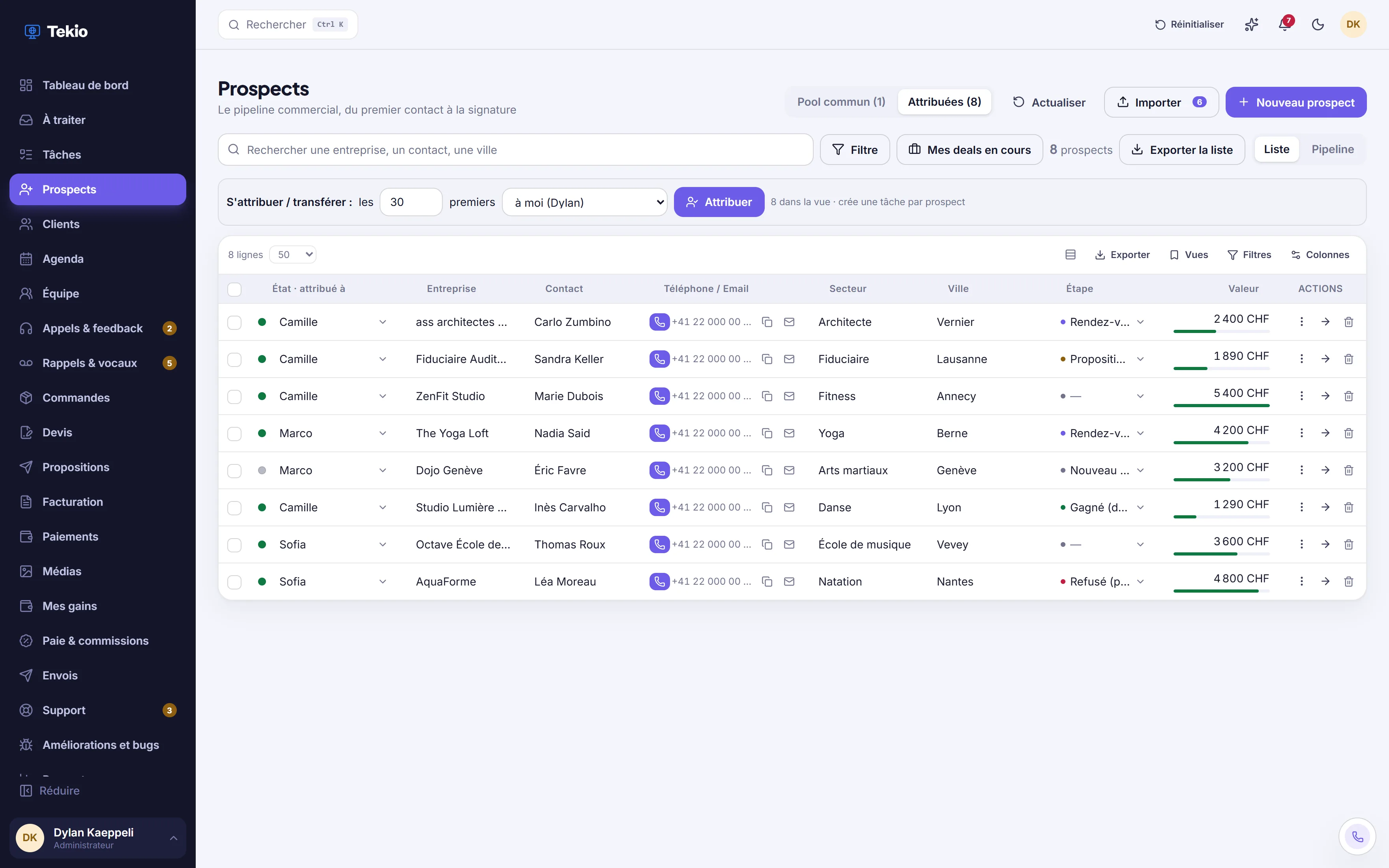
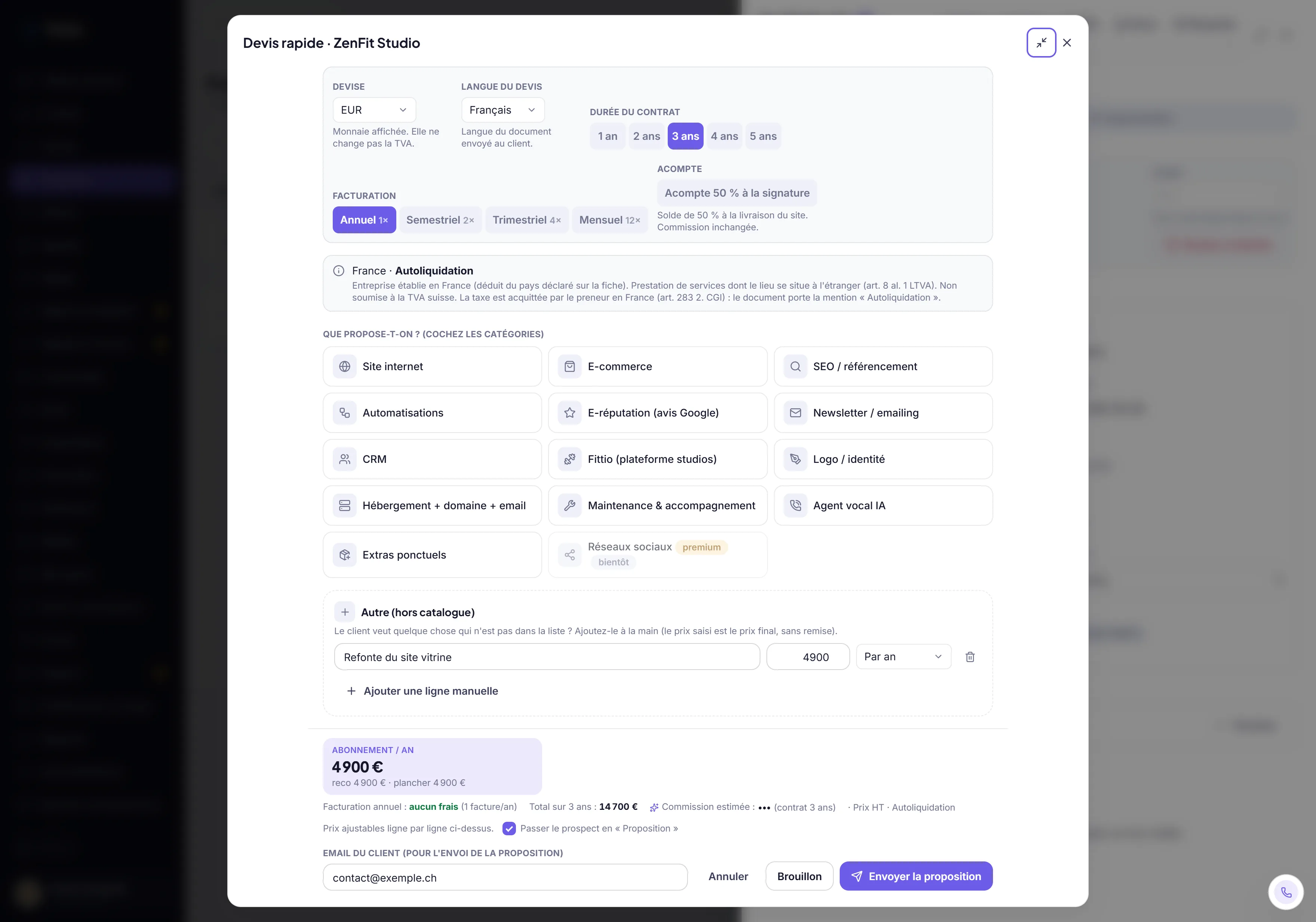
Screenshots of the Tekio CRM in demo mode, fictional data.
What becomes of a proposal sent to a prospect?
It appears in a dedicated queue with its amount, the date it was sent, who sent it, who the follow-up is entrusted to and the date of the last contact. With no news for seven days, it moves to attention. After fourteen, to critical.
The follow-up has a name
Whoever sent the proposal is not always the one who follows it up. The column says who is responsible and since when, so that nobody assumes someone else is handling it.
The pipeline reflects reality
New and never called, not reached, to call back at an agreed time slot, appointment booked, proposal sent, won, lost. States that describe what happened, not decorative boxes.
A definitive refusal is respected
When a prospect asks not to be contacted again, their record is blocked permanently, not deleted. Erasing the record would erase the proof that we did register their request.
The conversion rates are readable
Call to appointment, appointment to quote, quote to signature, per person. Three rates that say where it jams, rather than a global revenue figure that says nothing.
What does this chain not do?
Three limits it is better to know before you build on it.
The Tekio CRM signature is not a qualified signature
A handwritten stroke, timestamped and sealed, yes. A qualified electronic signature certificate in the regulatory sense, no. Depending on your contracts, that distinction matters or it does not, and it has to be settled at the scoping stage.
Public signals do not replace the conversation
What the CRM measures from the outside opens the door. What gets you through it is what the prospect says themselves. The tool arms the rep, it does not sell in their place.
The service catalog stays the client's, not Tekio's
The services, the recommended prices, the floors and the discount rules are configured for your business. What is delivered is not our catalog in your colors.
How long goes by at your end between the call and the proposal?
If it is more than twenty-four hours, there is probably a re-entry somewhere. Thirty free minutes to find it and tell you what can be done about it.